The glass fibers are made of various types of glass depending upon the fiberglass use. These glasses all contain silica or silicate, with varying amounts of oxides of calcium, magnesium, and sometimes boron. To be used in fiberglass, glass fibers have to be made with very low levels of defects.
Fiberglass is a strong lightweight material and is used for many products. Although it is not as strong and stiff as composites based on carbon fiber, it is less brittle, and its raw materials are much cheaper. Its bulk strength and weight are also better than many metals, and it can be more readily molded into complex shapes. Applications of fiberglass include aircraft, boats, automobiles, bath tubs and enclosures, swimming pools, hot tubs, septic tanks, water tanks, roofing, pipes, cladding, casts, surfboards, and external door skins.
Other common names for fiberglass are glass-reinforced plastic (GRP),[2]glass-fiber reinforced plastic (GFRP)[3] or GFK (from German: Glasfaserverstärkter Kunststoff). Because glass fiber itself is sometimes referred to as “fiberglass”, the composite is also called “fiberglass reinforced plastic.” This article will adopt the convention that “fiberglass” refers to the complete glass fiber reinforced composite material, rather than only to the glass fiber within it.
Fiberglass is an immensely versatile material due to its light weight, inherent strength, weather-resistant finish and variety of surface textures.
The development of fiber-reinforced plastic for commercial use was extensively researched in the 1930s. It was of particular interest to the aviation industry. A means of mass production of glass strands was accidentally discovered in 1932 when a researcher at Owens-Illinois directed a jet of compressed air at a stream of molten glass and produced fibers. After Owens merged with the Corning company in 1935, Owens Corning adapted the method to produce its patented “Fiberglas” (one “s”). A suitable resin for combining the “Fiberglas” with a plastic was developed in 1936 by du Pont. The first ancestor of modern polyester resins is Cyanamid’s of 1942. Peroxide curing systems were used by then.
During World War II, fiberglass was developed as a replacement for the molded plywood used in aircraft radomes (fiberglass being transparent to microwaves). Its first main civilian application was for the building of boats and sports car bodies, where it gained acceptance in the 1950s. Its use has broadened to the automotive and sport equipment sectors. In production of some products, such as aircraft, carbon fiber is now used instead of fiberglass, which is stronger by volume and weight.
Advanced manufacturing techniques such as pre-pregs and fiberrovings extend fiberglass’s applications and the tensile strength possible with fiber-reinforced plastics.
Fiberglass is also used in the telecommunications industry for shroudingantennas, due to its RF permeability and low signal attenuation properties. It may also be used to conceal other equipment where no signal permeability is required, such as equipment cabinets and steel support structures, due to the ease with which it can be molded and painted to blend with existing structures and surfaces. Other uses include sheet-form electrical insulators and structural components commonly found in power-industry products.
Because of fiberglass’s light weight and durability, it is often used in protective equipment such as helmets. Many sports use fiberglass protective gear, such as goaltenders’ and catchers’ masks.
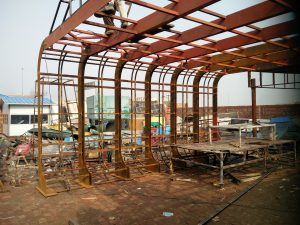
car parking shed, steel frame for the shed, steel structure for the shed, structural steel fabricators, steel fabrication companies, car parking structures ,manufacturers, Steel Structural fiberglass car parking shed, steel fabrication companies in Lahore, fiberglass fabrication near me, steel fabrication workshop.
We are an Engineering company established since 1998. Our services and products can be broadly categorized into “Fiberglass Fabrication” and “Steel Fabrication”. We are based in Lahore, but we have capacity to complete very big projects all over Pakistan. We have large working area available, sufficient labor resources, and readily available contractual labor option, which enables us to complete big assignments in short span of time.
ITI Engineering is headed by Mr. Abdul Hameed, a qualified Mechanical Engineer with vast and diverse mechanical engineering experience. He worked for 12 years in large Engineering Companies like “Heavy Mechanical Complex, Texila (HMC)”, EKL, and DUBAL (Dubai Aluminum Company. He has sharpened his skills by working for more than 4 years in one of the largest Engineering companies of Pakistan, “Descon Engineering”. The he moved to “Fiberglass” manufacturing and sales experience by working for almost 7 years in “GRP Engineering” & “BET”, both pioneers of fiberglass industry in Pakistan.
With excellent infrastructure, good engineering facilities, and experienced professionals, ITI Engineering can provide World Class service for all kinds of Fiberglass and Steel projects.
ITI Vision: “To provide World Class Engineering Services”
ITI Mission: “To deliver best quality in time by working according to our business values”
We are an Engineering company established since 1998. Our services and products can be broadly categorized into “Fiberglass Fabrication” and “Steel Fabrication”. We are based in Lahore, but we have capacity to complete very big projects all over Pakistan. We have large working area available, sufficient labor resources, and readily available contractual labor option, which enables us to complete big assignments in short span of time.
ITI Engineering is headed by Mr. Abdul Hameed, a qualified Mechanical Engineer with vast and diverse mechanical engineering experience. He worked for 12 years in large Engineering Companies like “Heavy Mechanical Complex, Texila (HMC)”, EKL, and DUBAL (Dubai Aluminum Company. He has sharpened his skills by working for more than 4 years in one of the largest Engineering companies of Pakistan, “Descon Engineering”. The he moved to “Fiberglass” manufacturing and sales experience by working for almost 7 years in “GRP Engineering” & “BET”, both pioneers of fiberglass industry in Pakistan.
With excellent infrastructure, good engineering facilities, and experienced professionals, ITI Engineering can provide World Class service for all kinds of Fiberglass and Steel projects.
ITI Vision: “To provide World Class Engineering Services”
ITI Mission: “To deliver best quality in time by working according to our business values”
Fiberglass roofing panels are more dimension ally stable than competing materials such as PVC or Poly carbonate.
Fiberglass roofing panels can be used over a much broader temperature range without
concern of wrap age, excessive expansion and contraction or cracking and brittleness
commonly associated with these competing products.
Range of roofing color and strength choices
Panels are available in various strengths and colors depending upon your particular application and budget. These range anywhere from our economical agricultural grade panels to our extra strong, woven roving reinforced industrial grade panels where strength, impact resistance and walkability is important.
Roofing suitable for use in highly corrosive environments
Fiberglass roofing panels are suitable for use in highly corrosive environments where exposure to chemicals or saltwater is a concern, are UV resistant to sun exposure and can be made with fire retardants if required.
Translucent reinforced corrugated fiberglass roof panels are ideal for:
residential awnings over patio decks and windows
pergola and gazebo coverings
carports
restaurant and commercial canopies and walkways.
Opaque fiberglass panels for roofing
Opaque fiberglass panels provide an ideal roof covering over plywood or
rafters and purlins thus eliminating the need for a built up roofing membrane such as
rubber or shingles.